
How to sit with your feelings (and why this is important for your wellbeing)

When I’m working with clients often a big aspect of the work we do together involves processing feelings. And it’s very common for people who come to therapy to be either very reactive when they feel a big feeling (i.e. lashing out, running away), or to be judgemental of their feelings (‘Why am I like this?’).
Very frequently I see clients who suppress (knowingly push away) or repress (unconsciously squash or push down) their feelings, especially if they’re deemed to be too difficult to deal with or come with negative self-talk such as ‘I’m too weak’, ‘I’m unlovable’ and ‘I’m such a failure’.
Using suppression or repression as a way of dealing with feelings is not overly helpful. We (and by that, I mean individuals and society at large) often view suppression of emotions as ‘being strong’ and keeping a stiff upper lip – not showing what we’re feeling in any way, and just keeping calm and carrying on. But there’s a price to pay for this approach.
This is because not facing a feeling doesn’t make it go away. And avoiding dealing with your feelings can look like unhelpful coping mechanisms, including addictive behaviours (abusing alcohol and other substances, gambling, problematic porn use, excessive shopping, over or under eating, over exercising, over working etc). And avoidance can lead to relationship problems and physical issues, such as exhaustion and burnout, while suppressing emotions is linked to stress, anxiety, muscle tension, IBS, autoimmune conditions, high blood pressure and other physical issues.
Thought, feeling or emotion?
It’s worth taking a moment to note the difference between a thought, a feeling and an emotion, because we often confuse these:
Emotions are physical (chemical) responses in your body and nervous system. They crop up quickly (often unconsciously) and are universal to all humans and include the biggies, such as fear, anger, joy. They might look like sweaty palms, a twinge in your tummy, or a quickening heartbeat when you experience something that scares you. Emotions alter your physical state and are instinctive – they are controlled by your central nervous system and they precede feelings.
Feelings are your awareness and experience of a physical emotion. A feeling comes AFTER an emotion, which is why therapists often ask where you are experiencing a particular feeling in your body, especially if you are struggling to name or explain how you are feeling. This is because they follow an emotion – for example, after your heartbeat increases and you start to feel panicky you might recognise that as fear.
Thoughts are the words, beliefs, opinions, or pictures in your head that attempt to explain a situation or make sense of something. It’s pretty normal for people to mix thoughts up with feelings – this happens a lot with clients who intellectualise their feelings in order to make sense of them (or as a defence mechanism). Some people are verbal processors and need to think out loud to make sense of their feelings, but it’s very easy to avoid ‘feeling the feeling’ by being ‘stuck in your head’.
How to deal with feelings in a healthy way
You might have heard the phrase ‘sitting with your feelings’ – but what does this mean? In reality it probably means stopping exactly what you usually do and trying something different. Something that might feel a bit challenging or uncomfortable.
At its essence, sitting with your feelings means allowing yourself to fully experience an emotion without distancing, distracting or pushing it away. It means slowing down, allowing it space and then thinking about what it’s trying to tell you. Feelings are really just messengers – they often lead the way to positive change. But we tag them with negative messages, i.e. ‘It’s bad to get angry – I’ve lost control’ rather than:
‘That made me feel really angry: I wonder why? When have I felt like this before in the past? What is this trying to tell me about this situation and myself?’
So, here’s how to do things differently – here’s what sitting with your feelings looks like:
- Allow yourself to fully experience an emotion without trying to fix, judge, or run away from it. Notice the physical sensations in your body, and breathe through the discomfort.
- Locate it in your body: Notice where the emotion lives physically. It might be a tight chest, a heavy stomach, tense shoulders, or a lump in your throat. It might be all of these things - or none.
- Pause and stop: Put down your phone, step away from tasks and find a quiet place to sit or lie down. You could also try going for a walk around the block or sitting in the garden. Shifting your view can give space and perspective.
- Be curious – ask yourself a question: Adopt a kind, compassionate and open-minded stance and ask: “What’s going on for me right now and what do I need in this moment?” Be curious about when you might have felt this before.
- Drop judgment: Remind yourself that it is completely okay to feel this way. Try to avoid labelling the emotion as "good" or "bad". Accept it.
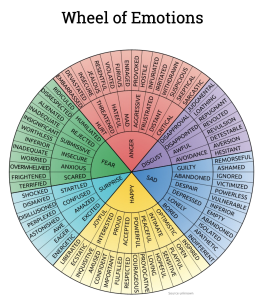
- Name the emotion: Give the feeling a label, such as sadness, anger, fear, or anxiety, to help create mental space. You can use the Wheel of Emotions to help you find the right word. Until you can name what’s going on for you, it’s very hard to process a feeling.
- Take slow, deep breaths. Do not try to force the feeling to go away; just watch how the energy moves through you like a wave. Research has shown that feelings last on average around 90 seconds. And remember: feelings are not facts. Walking while processing your feelings is often helpful but you could try shaking it out, letting out a long breath or sigh – or crying, if you need to.
Trust the process…
Your body knows, instinctively, what to do with feelings, if you allow it. The problems arise when we judge ourselves. If the thought of embracing your feelings seems alien, try a simple daily practice of Think, Feel, Act.
It works like this:
*Check in with yourself emotionally towards the end of the day. How was today? How am I feeling? What went on for me, feelings wise? What did I experience, physically? What were the triggers? Write down your thoughts on this.
*Ask: what was I feeling? Use the Wheel of Emotions to name your feelings – remembering that two things can be true at once. Don’t filter it: that implies self-judgement – just accept the feelings that come to you. Write them down.
*Reflect on a) what you wanted to do as a result and b) what you did instead. Note down what you might do in future to handle things differently.

The Think, Feel, Act exercise is a good way to be reflective and non-judgemental. You can use this as data for the future and if needs be, take this information and self-awareness to your therapist, if you get stuck.
To summarise, emotions, feelings and thoughts are all interconnected – like driving a car around Spaghetti Junction. But our heads and bodies are busy places, and things can get a bit messy. It can be tricky to identify what’s going on in your body, hard to name the right emotion and even harder to make sense of it all as a whole. And so it’s easy to keep going around that one-way system over and over again… unless you make efforts to interrupt the loop, change the way you view your feelings and look at them as signposts rather than something to avoid or be embarrassed about.
And if you’re struggling, find a therapist who can help you create your very own road map that makes sense to you so you can navigate your feelings in a way that’s healthier and more likely to lead to growth.