
How to cope with a panic attack
In my earlier blog ‘Five simple ways to calm an anxious mind’ I mention some simple tips to help you cope when things seem overwhelming. One of them – the 54321 technique – is an effective way to bring you into the here and now and grounding you when your mind is overwhelmed and spiralling.
What is a panic attack?
When anxiety hits it’s often because your brain is either dwelling on past events (common with those who’ve experienced trauma) or is catapulting ahead to perceived crises in the future (catastrophising). Often this can lead to a sense of panic, as the body goes into ‘fight or flight’ response or you experience one of the five Fs: fight, flight, freeze, flop, friend/fawn.
When this happens all manner of physiological responses kick in and stress hormones are released which bring physical symptoms, including:
* palpitations
* sweating (or chills)
* numbness
* trembling
* shortness of breath
* dizziness/lightheadedness
A panic attack can feel like a real medical emergency and is often accompanied by emotional responses including a sense of dread, terrifying fear of losing control and disassociation.
Why avoidance isn’t the best approach
Often the fear of having a panic attack feels bigger than actually experiencing a panic attack. And if you’ve experienced one, it’s fairly usual to try to avoid ‘the trigger’ so you don’t have another, which can make navigating life tricky: avoidance rarely works and what I see is that all that happens is that people’s lives shrink as people avoid things like public transport, crowded places, noisy spaces or going somewhere unfamiliar. As you might expect, this can lead to missed opportunities to connect with others or do what once brought joy.
If this is you, or someone you know, rather than shrinking your world to avoid potentially experiencing a panic or anxiety attack, it’s better to equip yourself with the tools to deal with one, should it arise. By doing this you widen your tolerance and build resilience to cope.
The problem with ‘strategies’ to cope with panic attacks is that in the moment, it’s all too easy to either forget what the strategy is or go into freeze or a disassociated state so you can’t access the tool you need that will help you.
That’s why keeping it simple is key:
- Take a breath and focus on the out breath – make the out breath long – like a deep sigh
- Hum to yourself
- Tell yourself out loud that you are safe – try speaking to yourself in the third person, i.e. ‘Julia is safe right now. She’s coped with this before and she can cope again. She’s got this. It feels like an emergency, but it really isn’t – it’s just your brain trying to keep you safe in the moment.’
- Try creating a 54321 ‘first aid’ kit
Introducing… the 54321 first aid kit
I did some trauma training recently and while in a breakout group with other counsellors and psychotherapists discussing stress responses, I had a brain wave. I could see that we were all struggling to recall what the five actions were, which was a bit limiting when it comes to sharing these techniques with clients. I mean, if we were struggling, how are we expecting someone experiencing a full brain/body stress response to recall what order the five actions were?
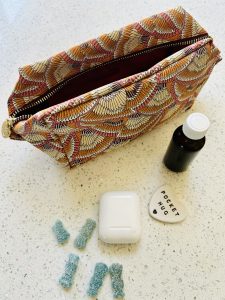
So I came up with the idea of a 54321 first aid kit. This is a pencil case or small zip-up bag that you fill with items not only help you to recall the five senses and the actions associated with them, but means you reassuringly always have the items to hand, should you need them.
What is the 54321 technique?
When anxious it can be hard to stay in the moment, so try using all five senses to ‘bring you back into your body’ or into the here and now.
So the 54321 is:
*5 = See – look around you: what can you see? Name 5 things you can spot in your environment
*4 = Touch – what can you feel? The edge of the chair, the ground under your feet, your toes in your shoe, a smooth surface? Can you run your hands under cold water or hold an ice cube in your hand or put a cold flannel on the back of your neck and spend some time thinking about how it feels?
*3 = Hear – What can you hear right now? Can you hear birds, train announcements, a snippet of conversation?
*2 = Smell - What can you smell? Breathe in and try to name the aromas that come up right now. Are they pleasant or evocative?
*1 = Taste – what can you taste in your mouth? Is there anything you’d like to taste? Can you get a faint hint of coffee or toothpaste or what you had for lunch?
The sight one is easy – most of us are able to scan our surroundings and find five things we can spot. The rest? Not so easy. That’s why filling your bag with items that will help you can be useful.
Here are some ideas:
*For touch, add a smooth pebble, crystal, sea glass, bubblewrap, some faux fur or soft velvet – something you find comforting or that has meaning
*For sound, pop in a set of headphones and listen to something calming – or try ASMR sounds or a meditation app. Some people find loud music helpful: rock is popular as is heavy house music. Try humming along to the music
*For smell, find an aroma you like – something that smells pleasant, familiar or evocative – and add it to you kit. This might be a fragrance sample or small bottle of aromatherapy oil or a lip salve or anything that you feel is comforting
*For taste – there’s some research that strong, unusual flavours can ‘confuse’ or shock the brain out of looping anxious thoughts. Look for extremely sour or sharp sweets or very strong mints and try putting those in your bag.
Chances are you won’t even need to use your first aid kit: clients tell me that just knowing they have something to hand, should they need it, is enough of a reassurance. I did a short video about this on Instagram - check out @kaythomascounselling to watch it
If you’ve tried a grounding technique that works well for you, I’d love to hear from you. Have you created a Five Senses First Aid Kit and found it worked? What did you put in it? Share your tips with others over on Instagram.
©Kay Thomas Counselling